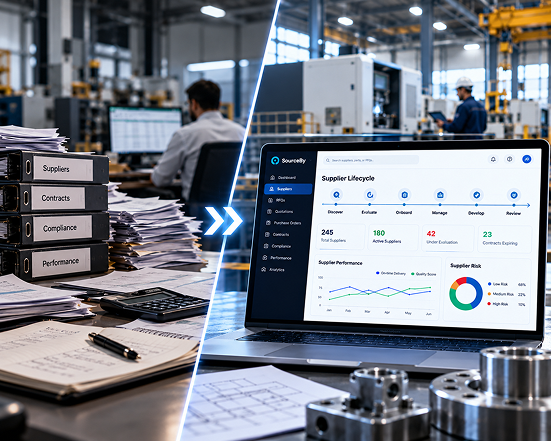
Vendor Management Software vs Supplier Lifecycle Management: What Industrial Buyers Actually Need
For industrial procurement teams, choosing vendor management software requires a clear understanding of what the system needs to manage. A tool that organizes vendor records and compliance documents can solve administrative problems yet still leave buyers struggling to identify qualified manufacturers for critical components.
Oct 29, 20265 min read
AD
Abhishek Daswadkar
Author
Share this blog:
Build your profile on Sourceby and connect with buyers running RFQs, BOM workflows, and structured sourcing events.
For industrial procurement teams, choosing vendor management software requires a clear understanding of what the system needs to manage. A tool that organizes vendor records and compliance documents can solve administrative problems yet still leave buyers struggling to identify qualified manufacturers for critical components.
The distinction matters for OEMs purchasing direct materials, custom-machined parts, fabricated assemblies, and engineered equipment. These purchases demand evidence of technical capability, production capacity, certifications, and sourcing suitability alongside accurate company records.
Vendor management typically focuses on maintaining supplier information and administrative controls. Supplier lifecycle management extends across discovery, qualification, engagement, evaluation, and sourcing decisions. Understanding the difference helps procurement leaders choose technology that addresses today's data gaps while supporting future manufacturing requirements.
Key Takeaways
Vendor management software suits teams that need organized vendor records, documentation, and administrative workflows.
Supplier lifecycle management connects supplier discovery and qualification with sourcing activities for direct materials.
Industrial buyers should evaluate capability data, document verification, traceability, and RFQ integration before selecting a platform.
The right choice depends on whether the primary problem is maintaining existing vendor records or finding and qualifying suppliers for complex sourcing requirements.
What Is the Difference Between Vendor Management and Supplier Lifecycle Management?
Vendor management software primarily organizes vendor information and administrative processes, while supplier lifecycle management covers the wider journey of identifying, qualifying, engaging, and evaluating suppliers for procurement decisions.
The terms often overlap because software vendors define their products differently. Industrial buyers should compare actual workflows rather than rely on product labels.
What vendor management software typically covers
A conventional vendor management solution helps procurement teams maintain records for approved business partners. Depending on the product, it can include:
Vendor registration details, tax information, and contact records.
Document storage, expiry reminders, and compliance status.
Approval workflows for new vendor creation and record changes.
Administrative reporting and integration with ERP or accounts payable systems.
These functions help teams maintain accurate records and reduce the time spent chasing paperwork. However, a complete vendor profile does not establish whether a manufacturer can produce a particular component to the required tolerances, volume, or delivery schedule.
What supplier lifecycle management adds
Supplier lifecycle management (SLM) connects supplier identification and qualification with sourcing activity. It can capture manufacturing processes, materials, certifications, production capacity, and location, then connect those details to RFQs, technical clarifications, quotations, and evaluation.
For example, an OEM sourcing a custom steel enclosure needs to know whether a supplier has suitable fabrication capabilities, can meet the production schedule, and has the required quality credentials. Administrative approval alone cannot answer those questions.
Sourceby's supplier lifecycle management platform connects structured supplier profiles with qualification, sourcing participation, and evaluation workflows.
The practical distinction is scope. Vendor administration answers, “Is this company registered and approved?” Lifecycle-oriented sourcing also asks, “Can this supplier meet our specific manufacturing requirement, and what evidence supports that decision?”
Which Solution Fits Industrial Direct-Material Procurement?
For OEMs sourcing direct materials, choose based on whether the priority is record administration or the full process of finding and qualifying suitable manufacturers. The following comparison describes typical capabilities; individual products vary.
Evaluation criterion
Vendor management software
Supplier lifecycle management
Primary purpose
Maintain vendor records and administrative controls
Company details plus processes, materials, capacity, and certifications
Document control
Collect, store, and track required documents
Connect documents to qualification criteria and sourcing decisions
Onboarding
Registration, approvals, and record creation
Registration plus technical and commercial qualification
Supplier discovery
Often limited to existing vendor directories
Search for suppliers by capability, location, and requirements
Direct-material sourcing
May require a separate sourcing system
Can connect supplier profiles with RFQs and technical requirements
Evaluation
Administrative status and compliance checks
Technical fit, commercial responses, capacity, and qualification evidence
Best-fit use case
Routine vendor administration and master-data governance
Complex manufacturing procurement and supplier selection
Why direct-material procurement changes the decision
Direct materials become part of the product being manufactured. A supplier's technical limitations can affect assembly quality, production schedules, warranty exposure, and customer commitments.
Consider an industrial equipment OEM looking for a precision-machined hydraulic component. Its existing vendor records contain tax details and an insurance certificate, but no current evidence of machining capability or available capacity.
A record-focused system helps maintain paperwork. A lifecycle-oriented platform can help buyers identify potential suppliers, assess their capabilities, collect technical and commercial responses, and compare candidates against the requirements.
Teams evaluating strategic sourcing should therefore check whether supplier data connects directly to RFQ execution and evaluation, instead of remaining in a separate administrative database.
How Should Industrial Buyers Evaluate Supplier Data and Document Control?
Industrial buyers should evaluate whether a platform keeps supplier records complete, evidence current, and qualification decisions traceable. Centralized storage is useful, but the quality of the information and its connection to procurement decisions matter more.
Check whether supplier data is complete and usable
Incomplete records often result from different departments collecting information independently. Engineering may hold capability assessments, quality may maintain audit reports, and procurement may store quotations in shared folders.
A suitable platform should support structured supplier profiles with fields such as:
Manufacturing processes, materials, equipment, and relevant certifications.
Production capacity, facility locations, and lead-time information.
Tax details, quality documentation, and required compliance records.
Qualification status, verification dates, and outstanding information requests.
Define mandatory fields by supplier category and criticality. A supplier providing standard packaging materials does not require the same technical evidence as a manufacturer producing a safety-critical assembly.
Make document control part of the workflow
Vendor onboarding software should support document submission, review, approval, and expiry tracking. For industrial suppliers, buyers also need to know which documents have been verified, who reviewed them, and whether the evidence remains valid for the intended application.
Before shortlisting a product, ask whether it can:
Flag missing or expired documents and assign follow-up responsibility.
Preserve document versions and approval history.
Restrict access to sensitive commercial or supplier information.
Link qualification evidence to the relevant supplier and sourcing event.
The National Institute of Standards and Technology's supply chain risk management guidance reinforces the need for defined supplier requirements and risk-management processes. Its cybersecurity focus is especially relevant when supplier relationships involve sensitive technical or digital information.
According to Dun & Bradstreet, Manufacturing Pulse Survey 2025, which covered 2,000 senior supply chain and procurement professionals across five key markets, 36% of surveyed firms felt they could make informed decisions with their existing data and 44% reported failed AI projects due to poor data quality. These findings highlight a practical procurement concern: technology cannot compensate for unreliable source data. Before investing in automation, establish who owns supplier records, how evidence is validated, and how often critical information must be reviewed.
How to Choose the Right Platform for Your Procurement Requirements
Choose a platform by testing it against real procurement scenarios, not by counting features on a product page. The evaluation should establish whether the software addresses your current administrative gaps and supports the supplier decisions your manufacturing operations require.
Apply a four-part evaluation framework
1. Define the procurement problem
If vendor creation, document expiry, and master-data accuracy consume most of your team's time, prioritize administrative controls. If buyers struggle to find qualified manufacturers or assess technical responses, prioritize lifecycle and sourcing capabilities.
2. Test a real supplier record
Use an existing supplier with incomplete documentation. Check how the platform identifies missing fields, assigns tasks, records approvals, and handles updated certificates.
3. Run a direct-material sourcing scenario
Give shortlisted vendors a sample RFQ involving drawings, material specifications, delivery requirements, and commercial terms. Determine whether the platform connects supplier capabilities with responses and evaluation.
4. Check integration and governance
Confirm how supplier information synchronizes with your ERP and other procurement systems. Ask about user permissions, audit history, data ownership, implementation effort, and ongoing maintenance.
During the evaluation, distinguish between supplier management software for maintaining existing relationships and tools that actively support supplier discovery and sourcing. A broad feature list is less useful than a successful demonstration of your actual workflow.
Also assess whether vendor onboarding software can accommodate different qualification rules by category, geography, and supplier risk. A flexible process helps avoid applying the same checklist to every supplier regardless of operational importance.
When does a broader lifecycle platform make sense?
A lifecycle-oriented solution is worth evaluating when procurement teams repeatedly rebuild supplier lists, request the same documentation, or compare technical quotations manually. It is particularly relevant when engineering and procurement need a shared view of supplier capability and qualification status.
Sourceby supports industrial supplier discovery, structured profiles, qualification, and sourcing workflows. Buyers can review the platform against their own requirements before deciding whether its scope fits their procurement model.
The software decision you make now will influence how procurement handles new manufacturing requirements as product portfolios, supplier networks, and compliance expectations change. Choose a system that fits your operating model while leaving room for more demanding qualification and sourcing needs.
A useful next step is to map one difficult purchasing category, identify its data gaps, and test whether prospective software can resolve them using real supplier records and RFQ requirements. Sourceby's team can walk your procurement team through the platform and help you assess its fit for industrial sourcing workflows. Schedule a platform demo today.
Frequently Asked Questions
What is vendor management software?
Vendor management software helps organizations maintain vendor records, collect required documents, manage approvals, and track administrative compliance. Depending on the product, it can also support performance monitoring, risk reviews, and integration with enterprise procurement systems.
Is supplier lifecycle management different from vendor management?
Yes. Vendor management often emphasizes administrative records and controls, whereas supplier lifecycle management connects discovery, qualification, engagement, evaluation, and award. The precise distinction depends on product capabilities, so buyers should compare workflows rather than labels.
Can vendor management software support direct material procurement?
Some platforms support direct-material procurement, but capabilities vary. Buyers should confirm whether the system captures manufacturing capabilities, certifications, production capacity, technical specifications, and RFQ responses rather than simply maintaining approved vendor records.
What should vendor onboarding software include for industrial suppliers?
Vendor onboarding software should support structured registration, document collection, approval workflows, expiry alerts, and verification history. Industrial buyers should also check whether technical qualifications, quality certifications, and category-specific requirements can be recorded and reviewed.
When should a company consider supplier management software?
Supplier management software becomes worth evaluating when supplier information is fragmented, qualification checks are repetitive, or sourcing teams lack reliable evidence for supplier decisions. Direct-material buyers should also assess discovery, RFQ integration, and technical evaluation.
How can procurement teams compare supplier lifecycle platforms?
Start with a real purchasing scenario and test supplier data completeness, document verification, qualification rules, RFQ handling, and auditability. Compare integration requirements, implementation effort, and total cost before selecting a platform that fits your operations.
We use cookies to give you the best possible experience on our website. We use cookies to enhance your browsing experience, serve personalised ads or content, and analyse our traffic. By clicking “Accept All”, you agree to the storing of cookies on your device to enhance site navigation, analyze site usage, and assist in our marketing efforts.
Cookie Preferences
Manage your cookie preferences below:
Essential cookies enable basic functions and are necessary for the proper function of the website.
Name
Description
Duration
Cookie Preferences
This cookie is used to store the user's cookie consent preferences.