Sheet Metal Fabrication Companies: How to Shortlist Partners for Heavy Equipment Parts
A loader cab panel, a hydraulic tank and a counterweight bracket can land on the same RFQ, yet they need very different shops. One calls for tight bends in 3 mm steel. Another needs 20 mm plate, full penetration welds and a coating that passes 1,000 hours of salt spray.
Nov 10, 20265 min read
AD
Abhishek Daswadkar
Author
Share this blog:
Build your profile on Sourceby and connect with buyers running RFQs, BOM workflows, and structured sourcing events.
A loader cab panel, a hydraulic tank and a counterweight bracket can land on the same RFQ, yet they need very different shops. One calls for tight bends in 3 mm steel. Another needs 20 mm plate, full penetration welds and a coating that passes 1,000 hours of salt spray. Most sheet metal fabrication companies list "cutting, bending, welding" on their websites, which tells a buyer almost nothing about fit. This guide sets out the shortlisting criteria that matter for heavy equipment parts and how to verify each one before quoting begins.
Key Takeaways
Heavy equipment parts span thin sheet and thick plate, so the first filter is the thickness range a shop cuts, bends and welds at production quality.
Cutting and forming capacity should be checked as machine specifications: laser power, plasma bevel capability, press brake tonnage, and bed length.
Welding qualification needs two layers of proof: the code a shop works to (AWS D1.1, D1.3 or ISO 3834) and current welder certifications.
Coating and assembly decide total cost and lead time more often than cutting does, so confirm what happens in-house.
What Heavy Equipment Buyers Need from Sheet Metal Fabrication Companies
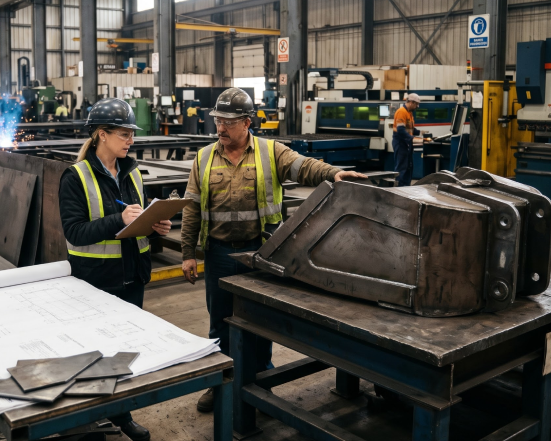
Heavy equipment programs need fabricators that handle both sheet and plate inside one quality system. Sheet usually means material under about 6 mm (roughly 1/4 inch). Plate starts above that. A single excavator or tractor bill of materials can include guards and panels in 2 to 4 mm sheet alongside frames and brackets in 12 to 25 mm plate.
That split changes who qualifies. Precision sheet shops often run high speed fiber lasers and small press brakes. Structural steel fabricators run plasma tables, large brakes and heavy welding bays. Buyers who send a mixed package to only one type tend to get a partial quote, or a price padded for subcontracted work.
Why Fabricator Capability Stays Hidden
Capability is hard to see because fabricator websites describe processes, not limits. "Laser cutting" does not reveal maximum thickness, sheet size or how many machines can run the job at once. Equipment lists published by sheet metal fabrication companies rarely show age, utilization or which operations are subcontracted. Certificates on a website may cover a sister plant, and photos of a large press brake say nothing about whether it is booked through the next quarter.
Labor adds a second blind spot. A shop may own four welding cells, but staff only two shifts on one of them.
For fabrication suppliers, those gaps show up as welding and press brake capacity that exists on paper but not on the floor. Buyers who ask only about equipment miss the constraint that sets real lead time.
Shortlisting Criteria for Heavy Equipment Fabrication
Six criteria separate a qualified partner from a shop that can quote. Ask for each as a specification with evidence, not a yes or no answer.
Thickness range
Ask for the thickest and thinnest material the shop cuts, bends and welds at production quality, by material. Mild steel, AR400 wear plate and stainless behave differently. A shop that cuts 25 mm mild steel may not bend AR400 above 10 mm without cracking. Request recent part examples at your target thickness.
Laser, plasma and cutting capacity
Fiber lasers give clean edges and tight tolerances on thin and medium gauges. High-definition plasma handles thicker plate faster and can cut weld bevels in one pass. Ask for laser power, plasma amperage, maximum sheet size, bevel capability, and the number of machines. One large table is a single point of failure. Sheet size limits matter too: a shop limited to 1.5 x 3 m sheets cannot nest a 4 m side panel without a joint.
Press brake tonnage and bed length
Ask for tonnage and bed length together. A 400-ton brake with a 3 m bed and a 400-ton brake with a 6 m bed serve different parts. Confirm the thickest plate the shop bends at your part length, the tooling it owns and whether it can hold your bend angle tolerance across the full bend.
Welding codes and certifications
Ask which code governs the work. AWS D1.1 covers structural steel, while AWS D1.3 covers sheet steel. The AWS D1.1/D1.1M:2025 edition is the current release of the structural code. For international programs, check whether the shop holds ISO 3834 certification and at which level: Part 2 (comprehensive), Part 3 (standard) or Part 4 (elementary). Then request welder qualification records, WPS documents, and whether a Certified Welding Inspector works on site.
Coating and finishing
Heavy equipment parts often need powder coat, wet paint, electrocoat or hot dip galvanizing, and each has its own spec. Ask which finishes run in house, the largest part the paint line accepts and how coating performance is tested, such as salt spray per ASTM B117. Outsourced galvanizing can add a week or more of transit and queue time.
Assembly and value-added work
Ask whether the shop installs hardware, machines, weldments after welding, kits parts or delivers subassemblies. Custom fabrication that ends at a raw weldment pushes work back onto your plant. A partner that delivers a painted, machined, and assembled bracket removes two or three handoffs.
Comparing Types of Fabrication Companies
Sheet metal fabrication companies are not one category, and not every shop competes for the same work. The comparison below shows where each common type fits for heavy equipment programs.
Shop type
Typical thickness strength
Strengths
Common gaps
Best fit
Precision sheet metal job shop
Thin to medium sheet
Tight tolerances, fast laser and punch work, hardware insertion
Limited plate bending, small paint lines
Guards, panels, enclosures, cab parts
Structural steel fabricator
Medium to heavy plate
Large plasma tables, heavy brakes, D1.1 welding
Looser tolerances on thin parts
Frames, booms, counterweights, platforms
Integrated contract manufacturer
Sheet and plate
Cutting through coating and assembly under one roof
Higher minimums, longer onboarding
Mixed packages and subassemblies
Many OEMs end up with two or three fabrication suppliers by part family rather than one partner for everything. The decision often turns on how much assembly and coating the plant wants to keep in house.
How to Build a Verified Shortlist
A verified shortlist comes from structured data, not referrals alone. Start with a search filtered by process, thickness, certification and region. A structured supplier discovery workflow lets teams compare fabrication companies against the same fields instead of reading brochures one at a time. It also shows which fabrication suppliers already hold the certifications a program needs.
Group your parts into families by thickness, weld code and finish.
Send each family's requirements as a structured questionnaire, with drawings and annual volumes.
Score replies on the six criteria above, weighting the ones that drive your cost.
Request a first article from the top two and audit the welding and paint processes on site.
As an illustrative example, an OEM sourcing a compact loader program might split its package three ways: cab panels to a precision sheet shop, the boom and frame to a structural fabricator, and the hydraulic tank to whichever of the two passes a leak test protocol. Each group gets its own custom fabrication criteria and its own shortlist, and fabrication companies that cover two groups earn a scoring bonus.
Watch for warning signs: a quote with no WPS references, a coating spec answered with "we use a partner," or an equipment list that has not changed in a decade. Custom fabrication programs fail most often at the handoffs nobody asked about during quoting.
Conclusion
Fabrication sourcing for heavy equipment is moving from price comparison toward capacity planning. As skilled labor stays tight, the OEMs that hold lead times steady will be the ones that know which partners can absorb a volume spike in welding and paint, not only in cutting. Keeping that knowledge current, by part family and region, turns supplier selection into an ongoing advantage rather than a scramble at each new program. To see how verified capability data supports that work, schedule a demo.
Frequently Asked Questions
What should I check first when comparing sheet metal fabrication companies?
Start with thickness range by material. If a shop cannot cut, bend and weld your thickest and thinnest parts at production quality, other criteria matter little for that part family.
How do sheet metal fabrication companies differ from steel fabrication companies?
Sheet metal fabrication companies focus on thinner gauges and tight tolerances. Steel fabrication companies handle heavy plates and structural welding. Heavy equipment programs often need both, split by part family.
Which welding certifications matter for heavy equipment parts?
Ask for the governing code, usually AWS D1.1 for structural steel or AWS D1.3 for sheet steel. ISO 3834 applies to many international programs. Also request current welder qualification records.
Should coating be done by the fabricator or a separate supplier?
In house coating usually shortens lead time and reduces handling damage. Outsourcing suits specialized finishes like hot dip galvanizing but adds transit time plus another supplier to qualify and audit.
How many sheet metal fabrication companies should be on a shortlist?
Screen five to eight shops per part family against structured criteria, then take two through first article inspection. Audit welding and paint processes at the final choice before production starts.
How can buyers verify fabrication capacity before awarding work?
Request machine lists with specifications, utilization, and staffed shifts. Compare this against your volume. Verified supplier profiles from sheet metal fabrication companies speed up early screening, followed by on-site audits.
We use cookies to give you the best possible experience on our website. We use cookies to enhance your browsing experience, serve personalised ads or content, and analyse our traffic. By clicking “Accept All”, you agree to the storing of cookies on your device to enhance site navigation, analyze site usage, and assist in our marketing efforts.
Cookie Preferences
Manage your cookie preferences below:
Essential cookies enable basic functions and are necessary for the proper function of the website.
Name
Description
Duration
Cookie Preferences
This cookie is used to store the user's cookie consent preferences.