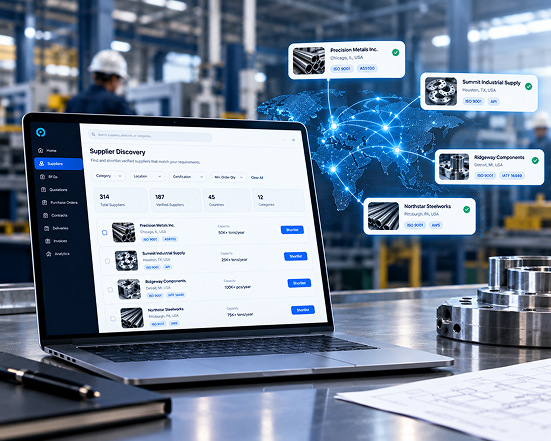
Supplier Discovery: How Industrial Buyers Find and Shortlist Qualified Suppliers
Industrial buyers need more than a long list of vendors. They need suppliers that can meet engineering specifications, maintain consistent quality, deliver within project timelines, and support production requirements.
Oct 28, 20265 min read
AD
Abhishek Daswadkar
Author
Share this blog:
Build your profile on Sourceby and connect with buyers running RFQs, BOM workflows, and structured sourcing events.
Industrial buyers need more than a long list of vendors. They need suppliers that can meet engineering specifications, maintain consistent quality, deliver within project timelines, and support production requirements. Effective supplier discovery helps procurement teams identify manufacturers and service providers whose capabilities align with these needs before investing time in detailed evaluations.
For OEMs, equipment manufacturers, and industrial procurement teams in the United States, the challenge is finding the right supplier across fragmented directories, referrals, trade shows, and digital platforms. A structured approach makes the search more precise and reduces the risk of overlooking capable vendors. It also creates a stronger foundation for strategic sourcing, supplier management, and long-term supply continuity.
Key Takeaways
Define technical requirements before searching to avoid irrelevant supplier matches.
Compare manufacturing capabilities, certifications, capacity, and location rather than relying on category names alone.
Verify supplier credentials before inviting vendors to a formal sourcing event.
Use structured digital workflows to connect supplier discovery with evaluation and purchasing decisions.
What Is Supplier Discovery?
Supplier discovery is the process of identifying potential suppliers that can meet a specific requirement, based on capabilities, certifications, capacity, location and compliance, before they are invited to quote. In industrial procurement it moves from defining the requirement, to capability-based search, to verification, and then to an RFQ with a qualified shortlist.
In heavy engineering, the process extends beyond finding a company that sells a particular component. A buyer procuring a large, machined housing, for example, needs to establish whether a manufacturer can handle the material, dimensions, tolerances, production volume, inspection requirements, and delivery schedule.
A disciplined approach to supplier discovery helps procurement teams:
Find manufacturers beyond their existing vendor network.
Identify specialized production capabilities.
Build alternative supply options for critical components.
Improve the quality of supplier shortlists before requesting quotations.
It also supports the broader source to pay process by helping teams establish a relevant supplier pool before commercial evaluation and purchasing begin.
How Does Supplier Discovery Work?
A practical supplier discovery process follows four steps: define the requirement, search by capability, verify potential suppliers, and engage suitable candidates through a structured sourcing request.
Define the requirements: Document specifications, quantities, delivery expectations, and mandatory standards.
Search by capability: Find suppliers with the required manufacturing processes, equipment, materials expertise, and geographic coverage.
Verify the shortlist: Review business credentials, certification validity, technical documentation, and references.
Engage through an RFI or RFQ: Collect missing capability information or request comparable commercial quotations.
Step 1: Define the requirement
Start with a clear statement of what the business needs to buy and the conditions a supplier must meet. Vague requirements produce broad search results and make vendor comparisons less reliable.
Identify the part or service, material, manufacturing process, annual or project volume, target geography, delivery schedule, and any non-negotiable compliance requirements.
What to include in a sourcing requirement
Prepare a specification package that covers:
Drawings and models: Current engineering drawings, CAD files, and revision numbers.
Material grade: Required alloy, specification, or material standard.
Tolerances and quality: Critical dimensions, inspection criteria, testing, and traceability.
Volume: Prototype quantity, batch size, and estimated annual demand.
Delivery: Destination, required dates, packaging, and logistics expectations.
Certifications: Required quality-system approvals, industry standards, or process qualifications.
Separate mandatory requirements from preferences. For example, an essential welding qualification should be a pass/fail condition, while proximity to the plant may be a weighted preference.
Step 2: Search by capability, not just category
Search using manufacturing capabilities because suppliers within the same category can have very different equipment, process expertise, and production limits.
A directory may classify two companies as machining suppliers, even though one specializes in small precision parts, and the other handles large industrial components. Both fit the category, but only one may fit the actual job.
Capability filters that matter in heavy engineering
Use filters that reflect the physical and operational demands of the part.
Manufacturing processes
Look for relevant experience in CNC machining, casting, forging, fabrication, welding, and heat treatment. A supplier's process list should match the operations required to produce the finished component, not merely a related industry.
Certifications
Check requirements such as ISO 9001 for quality management, IATF 16949 for applicable automotive supply chains, and relevant welding qualifications under AWS standards or ISO 3834. Confirm that certificates are current and apply to the correct facility and scope.
Capacity and machine envelope
Check maximum part dimensions, machine travel, lifting capacity, casting or forging limits, monthly output, and available production capacity. A supplier may own suitable equipment but lack room in its production schedule.
Illustrative Example: Matching a large ductile iron housing to the right foundry
Suppose an OEM needs large ductile iron housing. Two foundries report experience with ductile iron, but one has a smaller maximum pour weight and limited pattern-handling space. The other can accommodate the casting's weight and pattern dimensions.
The second foundry is the more relevant candidate, subject to checks on material properties, casting quality, machining allowances, inspection capability, and lead time. The example shows why material expertise alone does not establish manufacturing fit.
Step 3: Verify the shortlist
Before inviting suppliers to compete, confirm that their stated capabilities are supported by credible evidence.
Review business registration and KYC information, certification scope and expiry dates, manufacturing locations, technical documents, and relevant customer references. For critical components, request evidence of similar production work, quality controls, inspection equipment, and traceability practices.
Supplier verification should be proportionate to the risk. A standard consumable may need basic business and product checks; a safety-critical engineered component may require more extensive technical and quality review.
Keep verification results documented so that other stakeholders can understand why a supplier passed, failed, or requires further investigation. This supports more consistent supplier management after onboarding.
Step 4: Engage through an RFI or RFQ
Once the initial shortlist is credible, use a structured request to establish supplier fit and commercial viability.
An RFI (Request for Information) is useful when you need more details about capabilities, capacity, or experience. An RFQ (Request for Quotation) is appropriate when specifications are sufficiently defined for suppliers to price the requirement.
Standardized requests help suppliers respond to the same specifications and make it easier for procurement and engineering teams to compare technical compliance, price, lead time, and commercial terms. Connecting this stage to purchase to pay software can also help organizations maintain a more traceable path from supplier selection toward purchasing.
Supplier Discovery Vs. Supplier Sourcing Vs. Supplier Qualification
These three activities serve different purposes: discovery identifies potential suppliers, sourcing manages the competitive buying process, and qualification determines whether a supplier meets the required standards for approval.
Activity
Definition
Primary goal
Typical output
Main owner
Supplier discovery
Finding potential vendors
Identify relevant options
Initial supplier pool
Procurement / sourcing
Supplier sourcing
Engaging vendors and evaluating offers
Select a suitable commercial option
Bid comparison and award recommendation
Sourcing team
Supplier qualification
Assessing compliance and operational suitability
Establish supplier eligibility
Qualification decision and records
Procurement, quality, engineering
The stages can overlap, but they should not be confused. A supplier may appear suitable during discovery yet fail qualification because its certification is expired or its production capacity is insufficient.
For this reason, strategic sourcing treats supplier identification as an input to a broader decision process, rather than as a standalone search exercise.
Where Do Industrial Buyers Discover Suppliers Today?
Industrial buyers typically combine online searches, supplier directories, trade shows, referrals, and specialized digital platforms. Each channel offers different levels of reach, technical detail, and verification.
Discovery channel
Main advantage
Main limitation
Google and web searches
Broad access to manufacturers and niche suppliers
Capability information may be incomplete
Supplier directories
Organized company and category listings
Listings may not establish technical fit
Trade shows
Direct conversations and product demonstrations
Attendance takes time and limits reach
Referrals and industry networks
Trusted introductions and contextual knowledge
Can reinforce dependence on existing vendors
Digital sourcing platforms
Structured supplier profiles and search filters
Results depend on coverage and data quality
Supplier directories
Supplier directories help buyers explore a market, especially when they are entering an unfamiliar category or geography. They are useful for generating leads, but a listing alone does not prove that a vendor can manufacture a specific part or meet a particular production schedule.
Treat directory results as candidates to investigate, not approved suppliers.
AI-assisted supplier discovery platforms
AI-assisted platforms can help match a technical requirement against structured supplier information. Depending on the platform, matching may consider manufacturing processes, material expertise, certifications, equipment limits, capacity, and location.
For example, a buyer searching for a precision-machined steel component can narrow the field by material, tolerances, machine capability, and delivery region rather than relying on a broad search for machine shops.
AI-generated matches still require human review. Buyers should check how the system ranks candidates, which supplier data supports the match, and whether mandatory criteria are treated as exclusions or merely preferences.
Organizations may understand their direct suppliers better than the wider supply network. Expanding the pool of identifiable suppliers can support resilience, although visibility alone does not guarantee that alternatives are qualified or available.
What To Look for In a Supplier Discovery Platform?
A useful platform should help buyers find relevant vendors and move from initial search to an evidence-based shortlist without losing critical supplier information.
Use this checklist when assessing B2B sourcing technology:
Supplier coverage: Does it cover the components, materials, and services your business actually buys?
Technical filters: Can you search by manufacturing process, material, certification, location, and production capacity?
Verification information: Are business credentials, supporting documents, and verification status visible?
RFQ workflow: Can you invite shortlisted vendors to respond to a common set of specifications?
Collaboration: Can procurement, engineering, and quality teams review requirements and clarifications together?
Audit trail: Can you trace supplier invitations, responses, evaluations, and decisions?
Also consider how the platform fits your existing source to pay environment. Some tools concentrate on discovery; others connect discovery with RFQs, supplier evaluation, purchasing, and payment workflows. Purchase to pay software primarily supports the purchasing and payment stages, so buyers should confirm whether supplier discovery is included or requires a separate system.
How Sourceby Approaches Supplier Discovery for Heavy Engineering?
Sourceby helps industrial buyers discover and evaluate suppliers across categories spanning components, raw materials, and services, connecting supplier search with structured sourcing workflows.
Its approach is designed for requirements where technical fit matters as much as price.
Buyers can search using categories, capabilities, material expertise, certifications, location, and capacity. AI-assisted matching helps identify relevant candidates, while structured supplier information supports more consistent comparisons.
The workflow also connects discovery to RFQs, technical clarifications, response collection, and supplier evaluation. This gives teams a way to move from initial search toward more structured supplier management without treating each activity as an isolated task.
Conclusion
Supplier discovery is an opportunity to improve the quality of procurement decisions before commercial negotiations begin. For industrial OEMs, the longer-term value lies in developing a broader, better-understood supplier network that can support new product requirements, changing production volumes, and unexpected supply constraints.
As procurement teams evaluate their current approach, they should consider whether their tools make it easier to uncover alternatives, share supplier information across departments, and turn market knowledge into actionable decisions. If you are reviewing your discovery process, contact the Sourceby team to discuss your requirements and explore a demonstration of its industrial sourcing workflow.
Frequently Asked Questions
Is supplier discovery the same as sourcing?
No. Supplier discovery identifies potential vendors, while sourcing involves engaging them, comparing offers, and selecting a suitable option. Discovery creates the candidate pool; sourcing turns that pool into a purchasing decision.
What data should a supplier profile include?
A useful profile includes company and KYC information, product categories, manufacturing capabilities, materials expertise, certifications, locations served, contact details, production capacity, supporting documents, and verification readiness.
How do I find suppliers in India or Mexico?
Use capability-based searches with country, manufacturing process, material, certification, and capacity filters applied. Verify export experience, applicable standards, logistics, lead times, and documentation before shortlisting suppliers for a US-based operation.
How does AI improve supplier discovery?
AI can interpret sourcing requirements and match them against supplier capability data. Its usefulness depends on profile completeness, data accuracy, transparent matching criteria, and human verification of technical and compliance requirements.
How many suppliers should I shortlist for an RFQ?
There is no universal number. Invite enough credible suppliers to create meaningful competition while considering technical complexity, market availability, and evaluation workload. For specialized components, a few well-matched vendors may be more useful than a large generic list.
Can supplier discovery software support source-to-pay processes?
Yes, depending on the platform. Some solutions connect supplier discovery with RFQs, evaluation, and award workflows, while broader source to pay solutions may also support contracting and purchasing. Confirm which stages are included before choosing software.
We use cookies to give you the best possible experience on our website. We use cookies to enhance your browsing experience, serve personalised ads or content, and analyse our traffic. By clicking “Accept All”, you agree to the storing of cookies on your device to enhance site navigation, analyze site usage, and assist in our marketing efforts.
Cookie Preferences
Manage your cookie preferences below:
Essential cookies enable basic functions and are necessary for the proper function of the website.
Name
Description
Duration
Cookie Preferences
This cookie is used to store the user's cookie consent preferences.